

Most butane buyers are also nitrogen users. They just do not always think of it that way.
In a closed-loop hydrocarbon extraction system, nitrogen is the working gas that moves solvent from the tank into the column, pressurizes transfer lines, supports purge cycles, and is the tool you reach for during leak checks. It is not optional equipment. It is part of every run.
What follows is a practical explanation of how nitrogen functions in closed-loop extraction, the pressure parameters that matter, the purge and leak-check protocols that keep operators safe, and what to think through on the supply side when you are running both gases regularly.
Why Nitrogen, Not Butane Pressure, Does the Moving
Butane in a closed-loop system does not push itself. At operating temperatures, it produces vapor pressure, but using that vapor pressure to drive flow through the column creates a recovery problem at the end of the run and limits your ability to control flow rate precisely.
Nitrogen is introduced as a separate, inert pressurizing gas. It does not dissolve into the butane meaningfully, does not react with cannabis biomass, and does not contribute residual solvent to the extract. Its function is purely mechanical: it provides the pressure differential that moves solvent where you direct it.
This separation of roles, butane as the extracting solvent and nitrogen as the motive force, is what makes closed-loop hydrocarbon extraction controllable and repeatable at commercial scale.
Operating Pressure Ranges and Why They Matter
Nitrogen injection pressures in most commercial closed-loop systems run between 10 and 60 PSI depending on system design, column size, and the flow rate you are targeting. Operating outside the manufacturer’s recommended pressure range is the most common cause of seal failures, fitting leaks, and unexpected pressure events in the extraction space.
Lower pressure gives you slower, more controlled flow with more contact time between solvent and biomass. Higher pressure moves solvent faster but reduces contact time and increases the mechanical stress on fittings and vessels. Most operators find their preferred operating pressure through experience with their specific system and biomass, then lock it in as a documented parameter for consistency.
The safety logic behind nitrogen purging in hydrocarbon extraction follows the same engineering principles codified in NFPA 56, the standard for fire and explosion prevention during cleaning and purging of flammable gas piping systems, which defines purge-into-service and purge-out-of-service protocols for closed systems handling flammable gas.
In both cases, the principle is the same: inert nitrogen displaces oxygen or flammable vapor so that neither an ignitable atmosphere forms before butane is introduced, nor a hazardous one remains when the system is opened afterward.
Purge Cycles: What They Are and Why They Cannot Be Skipped
A purge cycle uses nitrogen pressure to remove residual butane from the system at the end of a run, or to prepare the system before a run begins. There are two types.
Pre-Run Purge
Before introducing butane into the system, a nitrogen purge clears residual air and moisture from lines, columns, and vessels. Air and butane create a flammable mixture within the explosive limits. Nitrogen, which is inert, displaces the air and establishes a safe atmosphere for butane introduction.
Skipping the pre-run purge is not a shortcut. It is removing the primary safety step that separates a controlled extraction run from an uncontrolled one.
Post-Run Purge
After solvent recovery, nitrogen pressure clears residual butane from dead legs, recovery coils, and lines that the recovery pump cannot fully evacuate. A thorough post-run nitrogen purge is what allows safe opening of the system for biomass unloading without residual butane vapor present.
Leak Checking with Nitrogen
Nitrogen is the standard gas for pressure-testing a closed-loop system before introducing flammable solvent. The protocol is straightforward: pressurize the system to operating pressure with nitrogen, isolate the source, and monitor for pressure decay over a defined window, typically 10 to 15 minutes.
A system that holds pressure has no significant leaks. A system that drops pressure has a leak that needs to be located and addressed before butane is introduced.
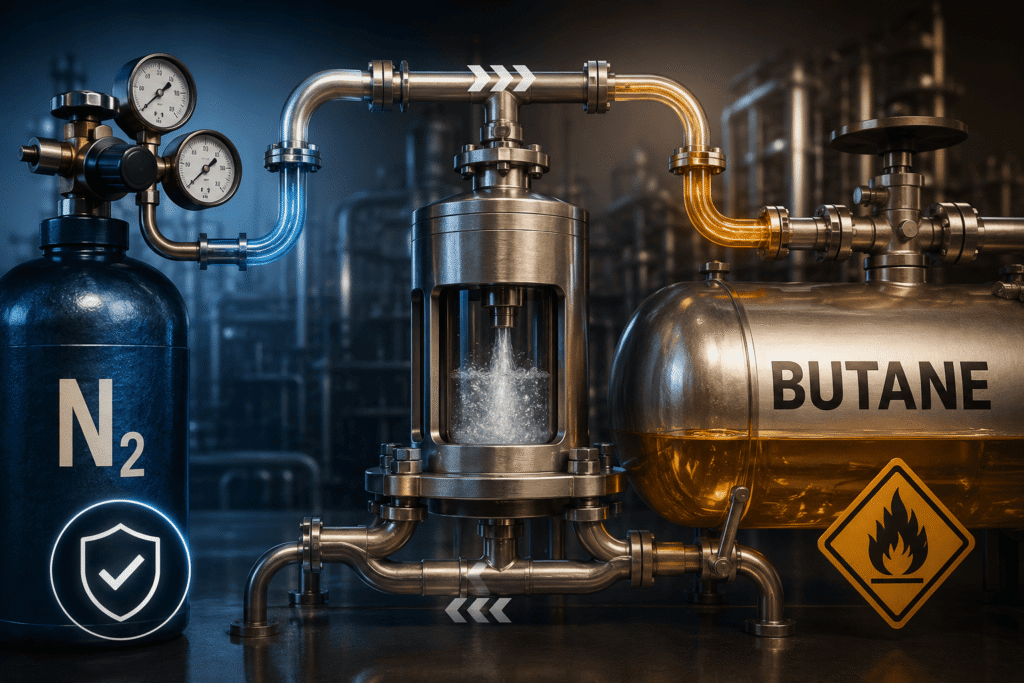
Nitrogen is used for leak checking specifically because it is inert and available in the lab without introducing flammable gas into a system that has not yet been verified as leak-free. Pressurizing with butane to find a leak defeats the safety purpose of the test.
Dewar vs. Cylinder: Supply Format Considerations
Nitrogen for extraction labs comes in two primary formats, and the right choice depends on your consumption rate.
High-Pressure Cylinders
High-pressure nitrogen cylinders in the 200 to 300 cubic foot range are the standard starting point for smaller operations. They integrate easily with existing gas manifolds, require no special storage infrastructure beyond securing against tip-over, and can be sourced through standard industrial gas channels.
For labs running multiple shifts, the cylinder change cycle becomes a logistics task. Running out of nitrogen mid-run because the cylinder depleted faster than expected is a disruptive event, and it happens more often than new operators anticipate.
Liquid Dewars
Cryogenic dewars convert to high-pressure nitrogen gas at point of use through a pressure-building circuit. For operations consuming nitrogen at commercial volumes, dewars dramatically extend the supply window between deliveries and reduce the cost-per-cubic-foot compared to high-pressure cylinders.
The upfront consideration is storage space and pressure-building time. Most mid-size to large extraction operations that have moved to dewar supply report the transition as straightforward and the cost savings as significant enough to justify the switch relatively quickly.
Managing Butane and Nitrogen as One Supply Relationship
Most extractors buying butane are also running nitrogen on the same schedule. Managing them as separate supplier relationships creates unnecessary scheduling complexity and more opportunities for a supply gap on either product to affect production.
AdChem supplies both butane and nitrogen to extraction labs across California and Colorado, with same-day delivery from East Bay and Los Angeles distribution hubs. Consolidating both gases into one delivery cadence simplifies logistics and eliminates the coordination overhead of managing two separate supplier relationships.
Request a bundled quote for butane and nitrogen together, sized to your throughput and your system’s daily nitrogen consumption. The AdChem team works with extraction operators at the supply planning stage, not just the reorder stage.